
Running a horse ranch takes more than passion, it takes smart equipment decisions. When you're managing daily feeding, mucking stalls, hauling hay bales, and moving supplies across acres of property, the right utility vehicle can be the difference between a smooth operation and constant back pain. This guide will help you think through what to look for when choosing a utility vehicle for your horse ranch, so you can find the right fit for your operation.
Why a Standard Truck Often Isn't the Answer
Most horse ranch owners already have a truck, and it's tempting to use it for everything. But full-size trucks come with real limitations on a working ranch. They can't navigate tight barn aisles or squeeze through standard horse stall doors. They're expensive to fuel for short-haul work around the property, and they're simply overkill for carrying a few bales of hay from the feed room to the paddock.
What most horse operations actually need is a compact, purpose-built utility vehicle, something designed to haul meaningful loads through the spaces where real ranch work happens.
Key Features to Look for in a Ranch Utility Vehicle
When evaluating utility vehicles for horse ranch use, pay attention to the following criteria:
Load capacity matters enormously. Hay bales, bags of feed, water buckets, and fencing supplies add up fast. Look for a utility vehicle rated to carry at least 1,000 lbs or more.
Turn radius is often overlooked but critically important. Barn aisles are typically 10–12 feet wide. A vehicle that can make tight turns without clipping stall doors or gate posts will save you endless frustration, and potential damage to your horses and equipment.
Durability is non-negotiable. Ranch environments are tough. Dust, manure, mud, and moisture take their toll. You need a vehicle built from heavy-gauge steel and designed to be hosed down and kept working through daily abuse.
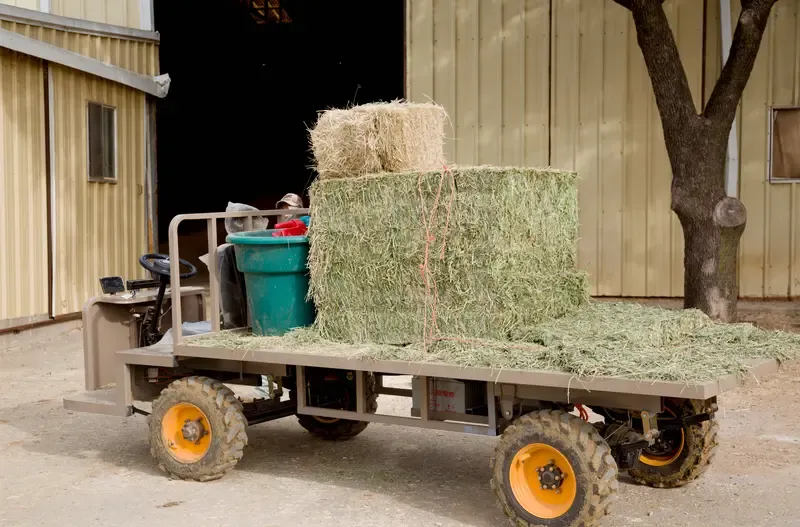
Two-seat capacity is a genuine advantage on a working ranch. When you're moving across the property, being able to bring a ranch hand or a family member with you saves time and makes the work more efficient.
Ease of maintenance is worth thinking about too. A ranch utility vehicle that requires specialized service or has hard-to-source parts will cost you more than you saved on the initial purchase.
Comparing Utility Vehicle Types for Ranch Use
Golf carts are sometimes repurposed as ranch vehicles, but they weren't built for it. They lack the load capacity, the structural durability, and often the ground clearance that real ranch terrain demands.
ATVs and UTVs (like side-by-sides) are purpose-built for rugged terrain, but they tend to be wide and challenging to maneuver through barn aisles and tight spaces. They're great for covering open ground, but not ideal for the close-quarters work that defines most daily barn operations.
Purpose-built compact utility carts (like the Sumo Cart) hit a different sweet spot. They're built low and wide for stability, narrow enough to navigate barn aisles and gate openings, and engineered to haul serious weight. With a two-seat configuration and rugged steel construction, a quality work cart like the Sumo Cart gives you the best of both worlds: real load capacity in a compact, maneuverable package.
Questions to Ask Before You Buy
Before committing to any utility vehicle for your ranch, work through these questions:
What are the narrowest spaces it needs to navigate? Measure your barn aisle, gate openings, and any tight turns on your property before you shop.
What's the heaviest load you'll need to carry regularly? Don't just think about what you haul today, think about the heaviest single-day load you might need to move during peak seasons.
Will you need two seats? If you regularly work with a ranch hand, trainer, or family member, a two-seat vehicle saves time and trips.
How important is local support? For ranches in more rural areas, having access to a local sales team who knows the product and can help you troubleshoot is worth real money.
Are fuel fumes and noise a concern around animals? If this is important to you, it might be worth considering an all-electric cart over gas-powered.
The Bottom Line
There's no single utility vehicle that's right for every horse ranch, but the criteria are consistent: load capacity, maneuverability, durability, and practical support. For most horse operations, the biggest gap in the equipment lineup isn't a bigger truck, it's a rugged, compact utility cart that can do the daily work that trucks and ATVs simply aren't built for.
If you're ready to put a purpose-built ranch utility vehicle to work on your property, the Sumo Cart is built for exactly that kind of operation. Call our team at 940-580-0767.